


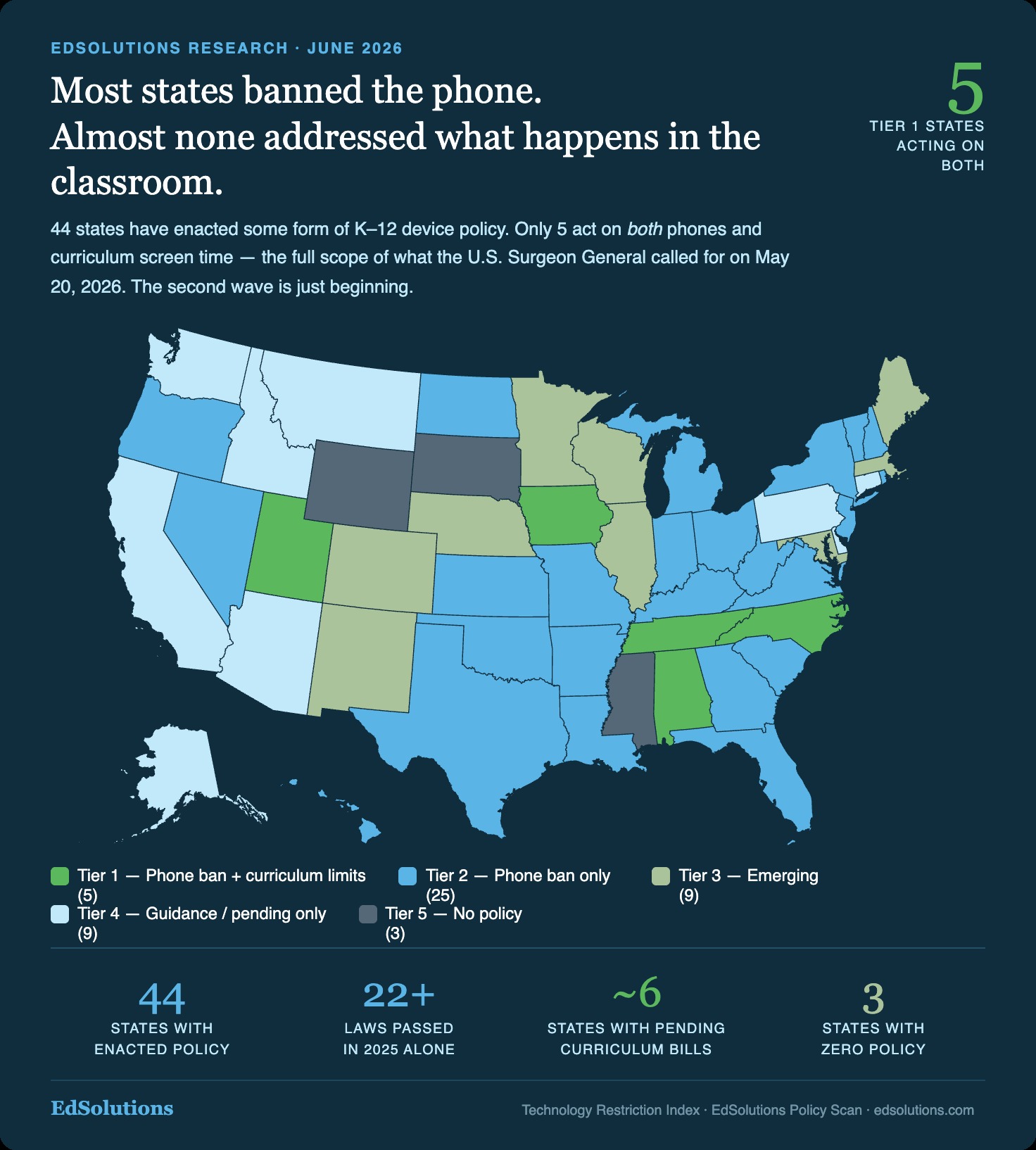
The phone ban wave got the headlines. The curriculum screen time wave is quieter, and it is the one with direct implications for what products schools can use and how they are deployed.
The EdSolutions Technology Restriction Index rates every state’s K–12 policy on two dimensions: personal device (phone) restrictions and curriculum or instructional screen time. Each is scored 0 to 3, and the combined score sets a state’s tier.
What the index shows
- 44 states have enacted some form of K–12 device policy.
- Only 5 states (Alabama, Iowa, North Carolina, Tennessee and Utah) act on both phones and curriculum screen time. That is the full scope of what the U.S. Surgeon General called for in the May 20, 2026 advisory.
- 25 states have phone bans only, leaving what happens inside the classroom largely unaddressed.
- 22+ laws were passed in 2025 alone, and about 6 states have curriculum screen time bills pending.
- 3 states (Mississippi, South Dakota and Wyoming) have no state policy.
| Tier | Definition | States |
|---|---|---|
| Tier 1 | Phone ban + curriculum limits | 5 |
| Tier 2 | Phone ban only | 25 |
| Tier 3 | Emerging | 9 |
| Tier 4 | Guidance or pending only | 9 |
| Tier 5 | No policy | 3 |
Why it matters for edtech and funders
The second wave is just beginning. Curriculum screen time rules will shape procurement language, product design and how digital tools are deployed in classrooms. Edtech suppliers should be asking now how this affects their go-to-market strategy. Funders should be asking which portfolio organizations are exposed.
Data as of June 1, 2026. Scores reflect state-level action only and do not capture district-level policies. Source: EdSolutions Policy Scan.